





Calculate Volumetric Weight Before You Pay for Shipping
Light but bulky parcels are often charged more than expected. With one simple formula, you can know the chargeable weight before you even pack.
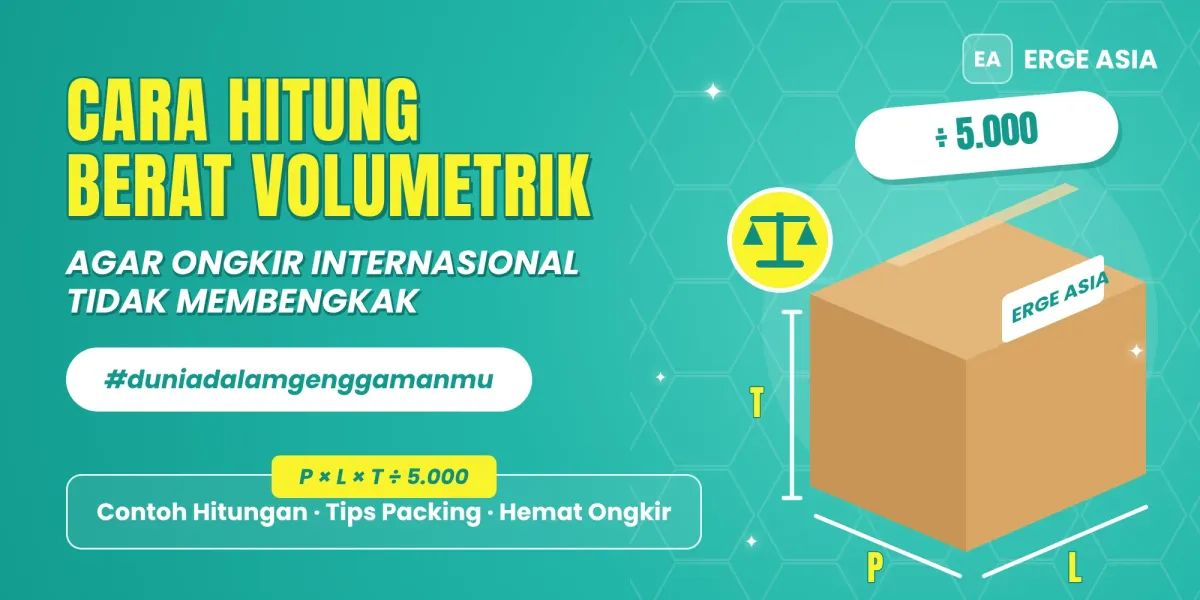
Volumetric weight in international shipping is weight calculated from a parcel's size, not from the scale. The formula: length × width × height in centimeters, divided by 5,000. Shipping is then charged on whichever is higher: the actual weight or the volumetric weight.
That's why a parcel of pillows or thick clothes can feel expensive even though it's light to lift. The box is big, so the chargeable weight grows with it.
In this guide you'll learn how to measure a parcel correctly, see real worked examples, understand size limits, and pick up packing tricks so international shipping costs don't balloon.
Volumetric Weight at a Glance
Everything to remember in one summary.
Why Does International Shipping Use Volumetric Weight?
Space on a plane is as valuable as weight.
- Limited cargo spaceA cargo plane can fill up with large, light parcels long before it reaches its weight limit.
- Fair for every senderSmall heavy parcels and large light parcels both pay for the space and load they actually use.
- Express industry standardAlmost every international air shipping service uses this method, though the divisor can differ.
Volumetric Weight vs Actual Weight
Two different numbers, only one gets charged.
- Measured on a scale
- Decides the cost for small, dense parcels
- Examples: books, ground coffee, spare parts
- Calculated from the box's length, width, and height
- Decides the cost for large, light parcels
- Examples: clothes, pillows, toys, chips
Simply put: if a parcel feels light for its size, the cost will likely follow volumetric weight. If it feels heavy for its size, the cost usually follows actual weight.
How to Calculate Volumetric Weight for International Shipping
Four steps, with just a tape measure and a scale.
Measure Length, Width, Height
Measure the outside of the box in centimeters, including any bulges or protruding parts.
Multiply and Divide by 5,000
Multiply the three numbers, then divide the result by 5,000 to get the volumetric weight in kg.
Weigh the Parcel
Weigh the fully packed parcel to get its actual weight.
Take the Higher Number
Compare the two weights. The higher one is the weight used to calculate shipping.
Common Mistakes When Measuring a Parcel
A few centimeters can change the chargeable weight.
- Measuring the inside of the boxWhat counts is the outside size, including the thickness of the box walls.
- Forgetting the bulgeAn overfilled box bulges, so its height grows when it's re-measured at the warehouse.
- Ignoring handles and protrusionsSuitcase handles, grips, or items sticking out count as part of the parcel's size.
- Wrong unitsMake sure every measurement is in centimeters, not millimeters or inches, before using the formula.
Volumetric Weight Calculation Examples
Three parcels with different results.
| Contents | Size (cm) | Actual weight | Volumetric weight | Chargeable weight |
|---|---|---|---|---|
| Clothes and pillows | 50 × 30 × 20 | 3 kg | 6 kg | 6 kg |
| Snacks and souvenirs | 60 × 40 × 25 | 5 kg | 12 kg | 12 kg |
| Ground coffee and sambal | 40 × 30 × 30 | 10 kg | 7.2 kg | 10 kg |
Look at the first parcel. It holds only 3 kg, but because the box is roomy, you pay as if shipping 6 kg, twice as much. The third parcel, being dense, is charged by its actual weight.
Once you know the chargeable weight, multiply it by the per-kg rate for the matching weight bracket. You can check per-kg rates for every country and weight range on our shipping rates page.
Parcel Size Limits and Dimensional Allowance
Two rules that are easy to miss when estimating shipping costs.
This allowance makes shipping to Taiwan friendlier for parcels of clothes and souvenirs. Make sure the recipient's details are complete too by reading how to upload the recipient's ARC to ship packages to Taiwan.
Packing Tips to Keep Volumetric Weight Down
Empty space in a box is a cost you don't need to pay.
- Choose a box that fits the contentsAn oversized used box is the most common reason shipping costs balloon. Trim or replace the box if there's still lots of empty space.
- Vacuum-pack clothes and pillowsVacuum bags can shrink soft items to a much smaller volume.
- Remove unnecessary packagingShoe boxes, toy boxes, or layered packaging can go if the item stays safe without them.
- Mix dense and light itemsFill gaps between light items with small, dense ones so the box space is fully used.
- Measure before sealing the boxCalculate the volumetric weight while packing. If it's far above the actual weight, there's still time to repack.
- Use multi-parcel shippingFor Taiwan, Singapore, and Malaysia, several parcels to the same recipient can be combined by weight for a lower per-kg rate, with at least 3 kg per parcel.
Need help choosing the right service? Read our guide to choosing an international shipping service.
Questions About Volumetric Weight
Quick answers to the questions our team hears most often.