

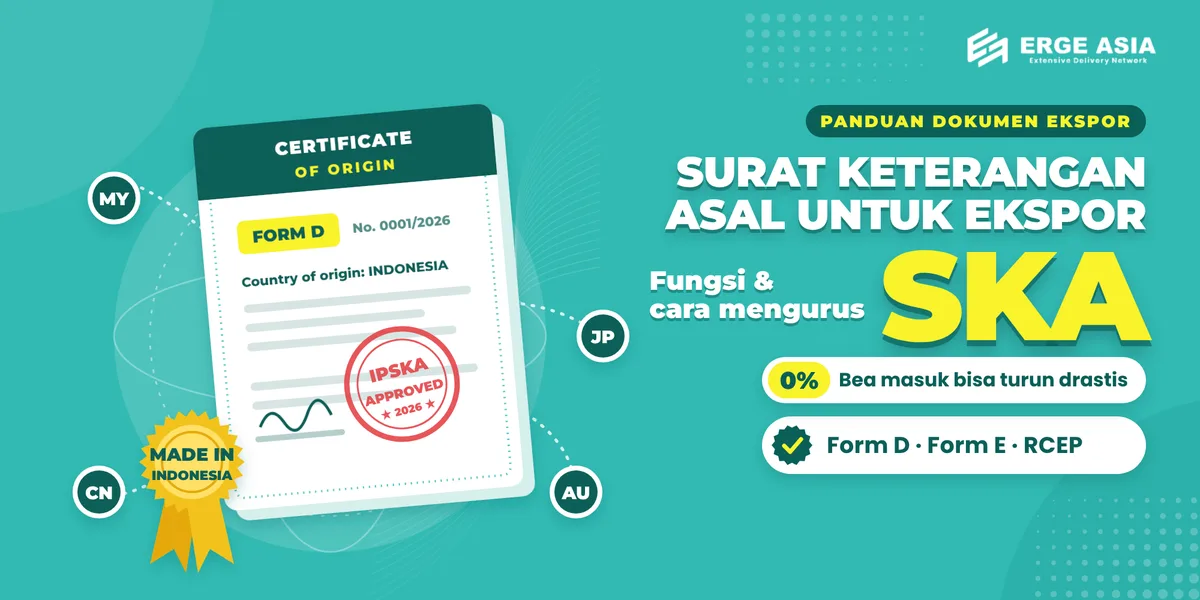
Certificate of Origin: Proof Your Goods Are Made in Indonesia
Overseas buyers sometimes ask for one extra document: an SKA, or certificate of origin. It can make import duty in the destination country much cheaper, even zero. This article covers what an SKA does, its types, the form for each country, and how to apply through e-SKA.
Preferential vs Non-Preferential SKA
- Used to get reduced or zero import duty
- Only for countries with a trade agreement with Indonesia
- The form follows the agreement, e.g. Form D or Form E
- Goods must meet the origin criteria in that agreement
- Gives no import duty reduction
- Used when the importer, bank, or destination country asks for proof of origin
- Can be used for any country
- Often requested in L/C transactions
Commonly Used SKA Forms
If there's more than one option, pick the agreement that gives the lowest tariff for your goods' HS Code.
| Destination country | Form / agreement | Notes |
|---|---|---|
| Malaysia, Thailand, Vietnam, Philippines, Brunei | Form D (ATIGA) | Within ASEAN, can be sent electronically (e-Form D) |
| Singapore | Form D (ATIGA) | Most goods are already duty-free, so an SKA is rarely needed |
| China | Form E (ACFTA) or RCEP | Compare the tariffs of both agreements |
| Japan | IJEPA, AJCEP, or RCEP | Choose the one with the lowest tariff |
| South Korea | IK-CEPA, Form AK, or RCEP | Choose the one with the lowest tariff |
| Australia | IA-CEPA, AANZ, or RCEP | Choose the one with the lowest tariff |
| Hong Kong | Form AHK | Free port, most goods carry no import duty |
| India | Form AI (AIFTA) | For goods on the tariff reduction list |
| Taiwan, Saudi Arabia, United States | Non-preferential | No preferential agreement in force yet; use when requested |
What You Need to Prepare
Don't have a proper invoice yet? See commercial invoice and packing list examples.
How to Get an SKA through e-SKA
Apply Online
Log in to ska.kemendag.go.id, choose the form type, enter the goods data, then upload the invoice, PEB, and B/L or AWB.
Wait for Review
An IPSKA officer reviews the application. If documents are complete, it is approved in the system.
Print and Sign
Print the approved SKA, then have it signed and stamped by the company head or an authorised representative.
Take It to the IPSKA Office
Bring the SKA with the original documents. The IPSKA officer signs and stamps it, and its status changes to issued.
Send It to the Buyer
Send the original SKA or a copy to the buyer as agreed. For e-Forms, the data is sent directly between countries.
Common Mistakes That Get an SKA Rejected
- Data doesn't match across documentsThe buyer's name, quantity, weight, or invoice number on the SKA differs from the invoice and AWB.
- Wrong HS CodeThe code on the SKA doesn't match the one used by customs in the destination country, so the preferential tariff can be refused.
- Wrong origin criteriaGoods with many imported materials may not meet the origin requirement. Check the agreement's rules before applying.
- Form doesn't match the countryFor example, sending Form D to a destination outside ASEAN. Make sure the form matches the destination.